Florida has more coastline than any other state in the lower forty-eight, and almost all of it is sand-bottom beach break. That is good news for anyone learning: there is no reef or rock underfoot, the waves are soft enough to fall off, and on most mornings there is a stretch of sand with nobody on it.
It is also why "the best surf spot in Florida" depends entirely on what you want from the session. This is the state as our instructors see it — the Space Coast where we teach, the inlet that has produced more Florida surfers than anywhere else, the north-east coast that catches the winter swell, and the Gulf, which is flat most of the year and brilliant for a few days after a tropical system passes. Sizes here describe what a break feels like, not a score out of ten.
Cocoa Beach is the learning capital
Wide sandbars, waist-deep inside sections and lessons running every day of the year. It is where we teach.
Sebastian Inlet is the serious one
The inlet jetty concentrates swell into the fastest, most hollow wave in the state. Not a first-timer's wave.
North-east catches the winter swell
New Smyrna, Ponce Inlet and Flagler see more size from November to March, with colder water and a wetsuit.
Mornings beat the afternoon
The sea breeze fills in after midday on every coast. The cleanest water of the day is before 11:00 AM.
How Florida surf actually works
Almost every wave that reaches a Florida beach was generated by weather within a few hundred miles, which makes this a windswell coast rather than a groundswell one. The exceptions arrive in late summer and autumn, when tropical systems send longer-period swell toward the state and the whole coast lights up at once.
That rhythm decides the year. From roughly June to November, a tropical system offshore is what produces the biggest and cleanest waves. From December to March, cold fronts crossing the peninsula drag north-east wind down the coast and the northern half of the state gets its most consistent surf. Summer is small, warm and glassy in the morning; the Gulf is mostly flat and only wakes up around a tropical system.
Tide matters as much as swell on a sandbar coast. An incoming tide pushes water over the bar and softens the wave, which is exactly what a beginner wants. A hard falling tide stands the wave up faster and drains the inside — fun if you can already turn, frustrating on day one.
- Best months for size: August to November, around tropical systems
- Most consistent winter surf: the north-east coast, New Smyrna northward
- Cleanest daily window: early morning, before the sea breeze fills in
- Cocoa Beach and the Space Coast: ridable small waves almost every week of the year
The Space Coast: Cocoa Beach and the beginner sandbars
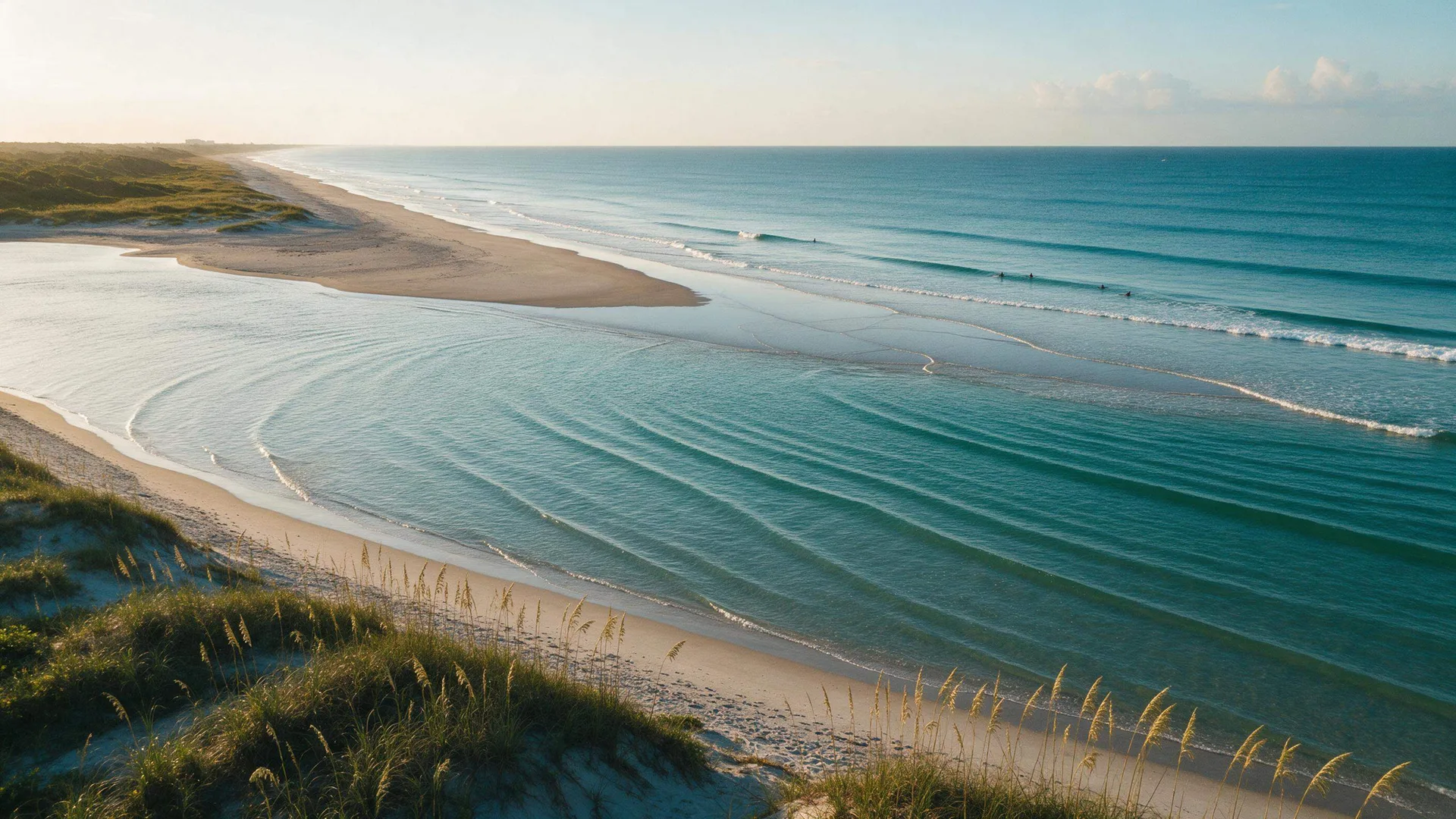
Cocoa Beach is a long, gently curved beach break with shifting sandbars along its whole length. That is the reason it has more surf schools per mile than anywhere else in Florida: the inside section is waist-deep, the waves break over sand and the reform is slow enough to practise a pop-up on. The pier is the landmark, Lori Wilson Park to the north is the usual teaching ground, and the south beaches toward Patrick Space Force Base are where you go when the crowd arrives.
Satellite Beach and Melbourne Beach continue south with the same sand-bottom character and a little more size on a solid swell. Spanish House, further south on A1A, is a step up again — a genuinely good wave that locals protect for good reason.
Playalinda, inside Canaveral National Seashore, is the wild card: undeveloped dunes, no buildings, seasonal hours and an entry fee. The waves can be bigger and cleaner than in town, but there are no lifeguards and no facilities, so it is not where a first lesson belongs.
Sebastian Inlet and the Treasure Coast
Sebastian Inlet is the benchmark. The rock jetty on the south side of the inlet concentrates whatever swell is running into a fast, hollow wave that breaks close to the rocks, and the current through the inlet is strong enough to matter even on a small day. It is where Kelly Slater learned to surf, and it is still where the state's best surfers go when a swell arrives.
Treat it as a place to watch before you paddle out. If you are comfortable in overhead surf, reading a moving lineup and paddling against current, it is one of the best waves on the East Coast. If you are not, the beach breaks north and south of the inlet — Vero, Fort Pierce, Stuart — offer the same swell with far more forgiving consequences.
North-east Florida: New Smyrna, Daytona, Flagler and St. Augustine
Drive north from Cocoa Beach and the wave quality climbs while the water temperature drops. New Smyrna Beach is the centre of it: the inlet produces a fast, shallow, powerful wave for experienced surfers, while the drive-on beaches either side offer peaks for everyone else. Ponce Inlet, just south, has strong currents around the jetties and a genuinely good wave on the right swell.
Daytona and Ormond hold plenty of peaks and are the easiest place in the state to find an empty one. Flagler Beach is small-town, consistent and friendly. Further north, St. Augustine — Vilano and Anastasia — picks up more swell than most visitors expect, but it is a winter coast: a wetsuit is not optional from December to March.
South Florida: Palm Beach to Miami
South Florida is a winter coast. Juno Beach and the Jupiter area pick up the biggest swell in the region, and Jupiter Inlet is a serious wave when a north-east groundswell arrives. Reef Road in Palm Beach is the other name locals mention, and it is not a beginner's break at any size.
The further south you go, the more the wave depends on a specific sandbar being right that week. Boca, Fort Lauderdale, Miami Beach and Key Biscayne all have surfers who know exactly which street end to check, and none of them have much to offer in summer. If you are in Miami for a week in July, expect flat water and plan around it.
The Gulf Coast: flat until it isn't
Siesta Key, Anna Maria Island, St. Pete Beach and Clearwater are beautiful, shallow and calm, which is why they are family favourites and why they are not surf destinations. Most days the Gulf is a swim, a paddleboard or a sunset.
The exception is a tropical system in the Gulf, when clean, long-interval waves can wrap onto the beaches for a day or two. Local surfers watch the forecasts and drop everything. If you happen to be there for it, it is one of the most photogenic sessions in the state — and the currents are as serious as anywhere.
Which Florida surf spot suits you
The useful question is not which break is best, but which break is best for the surfer you are today. A wave that is boring to an expert is often exactly right for a first lesson, and the reverse is how people get hurt.
- First lesson: Cocoa Beach and the Space Coast sandbars — waist-deep inside sections, soft reform, lifeguards
- Second and third session: Satellite Beach, Melbourne Beach, Flagler Beach on a small day
- Improving surfer: New Smyrna and Daytona peaks, Juno Beach when the swell is moderate
- Experienced: Sebastian Inlet, Ponce Inlet, Jupiter Inlet, Reef Road — all with currents and consequences
Why we teach on Cocoa Beach
We teach here because the beach does the hard part. The sandbars keep the waves small and crumbly most of the year, the inside is shallow enough to stand up in, and the beach is wide enough that a lesson never crowds anyone out. It is also the closest real ocean to Orlando — about 45 minutes from the airport on SR 528 — and ten minutes south of the Port Canaveral cruise terminals.
Every lesson runs from our Cocoa Beach break with a surfboard, rash guard and wetsuit included, and your instructor chooses the access point on the morning based on swell, wind, tide and how many surfers are already in the water. If you are travelling the state and want one session that actually gets you standing, this is the stretch of coast to book it on.
Ready to try it yourself?
Private, kids and group lessons run every day from 9:00 AM to 5:00 PM. Board, rash guard and wetsuit included.
Andrew Kinsman
Andrew owns Florida Luxury Surfing and teaches private, kids, family, couples and group lessons on this beach. The local detail in this guide is the same thing he tells guests on the sand before their first session.
Read his story