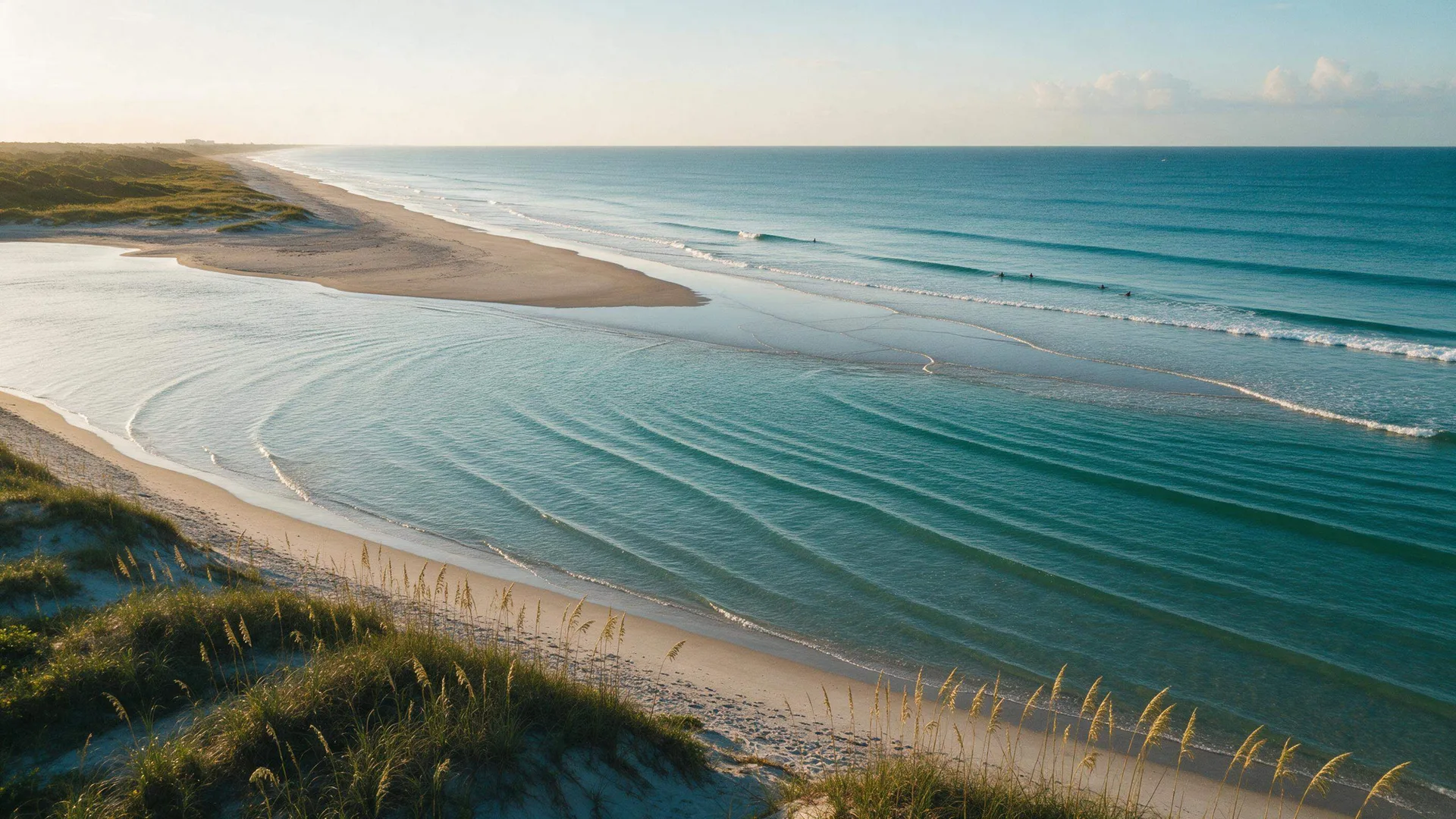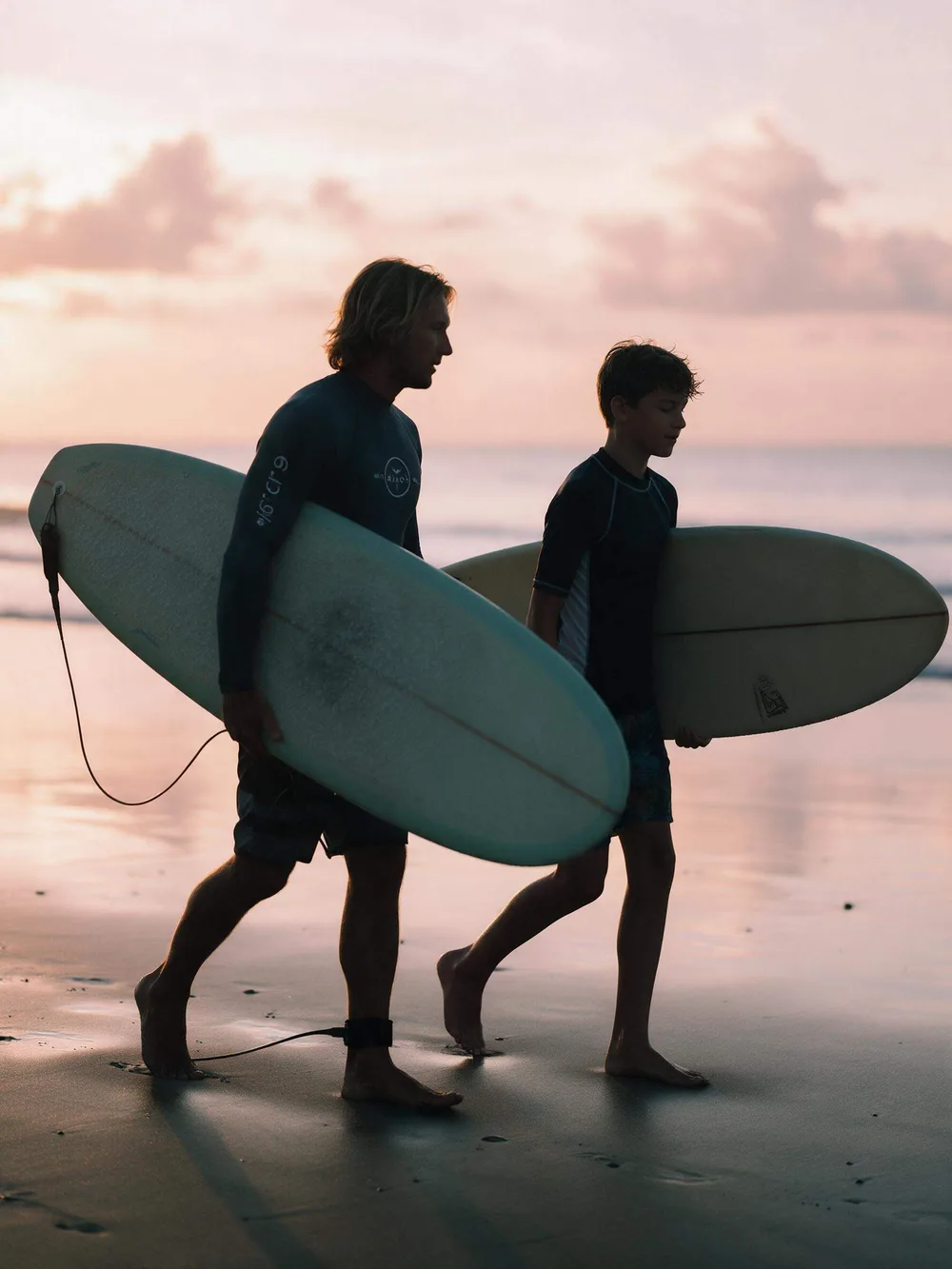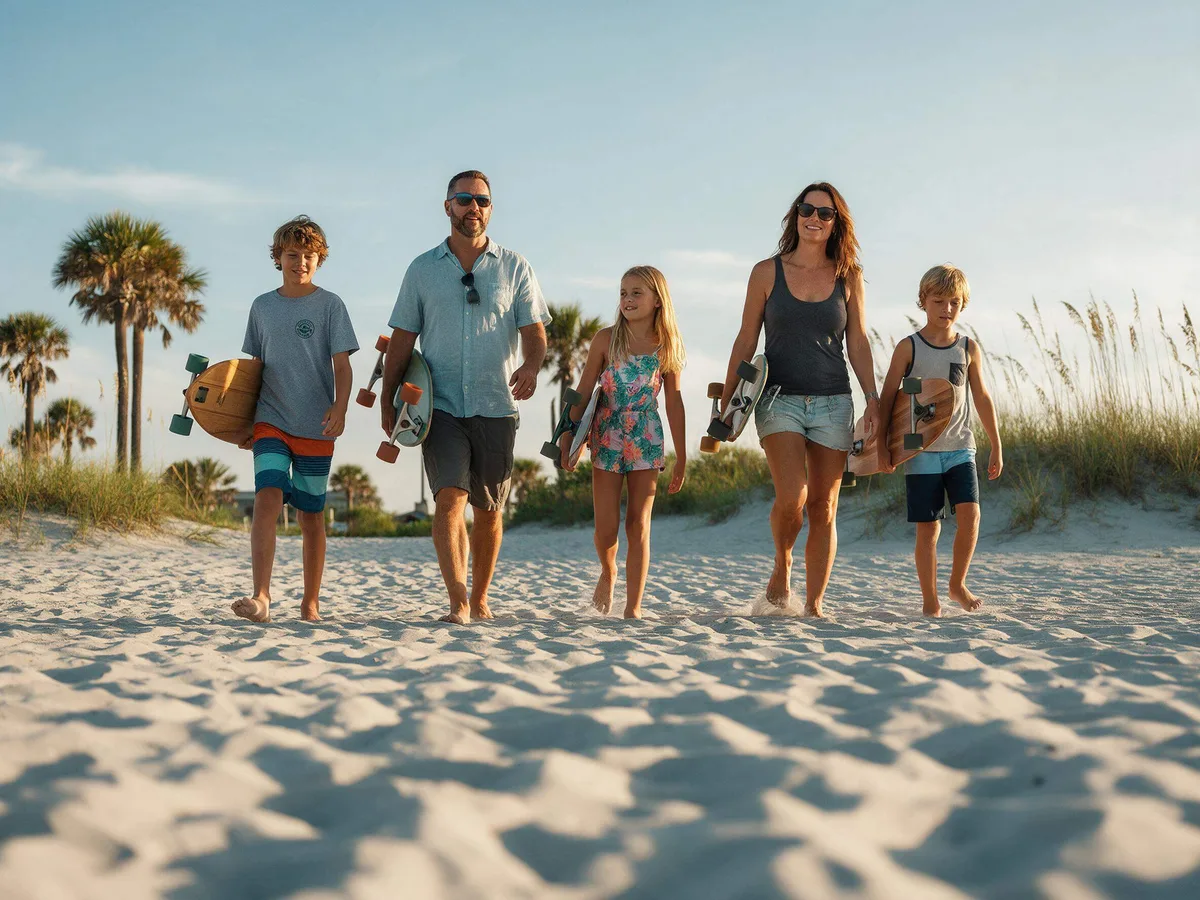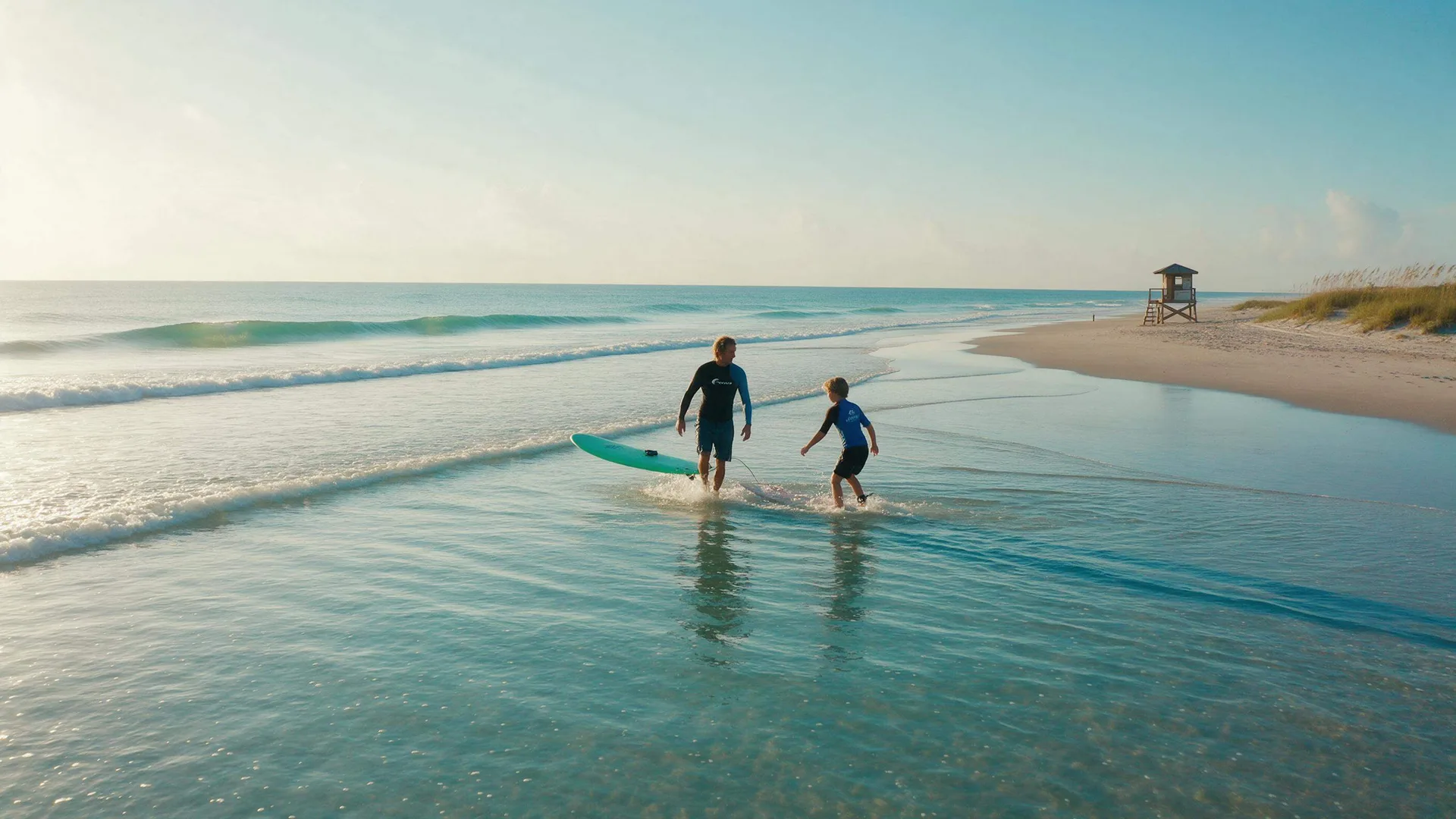
Cocoa Beach is a small barrier island town on Florida's Space Coast with one road running its length, the Atlantic on the east side of that road and the Banana River lagoon on the west. It is the closest real beach town to Orlando, the closest beach to the Port Canaveral cruise terminals, and one of the easiest places in America to stand on a surfboard for the first time.
This guide is the whole picture for a first visit: what there is to do, which beach suits you, where each part of town is good for staying, when to come, how to get here and around, what to do with children and what to do when it rains. The second half is the part we know best — how a beginner surf lesson fits into the trip, and how many sessions are worth booking.
Everything here is written by instructors who work this beach every day. Lessons run at 9:00 AM every morning, board, rash guard and wetsuit included, and requesting a time costs nothing.
Easy to reach
About 45 minutes from Orlando International Airport on the Beachline (SR 528), and ten minutes from the Port Canaveral cruise terminals.
One road runs the island
A1A carries you from the port down to Melbourne. The beach is always east, the restaurants, shops and lagoon always west.
Learn on a forgiving sandbar
Beginner lessons run every morning from 9:00 AM in waist-deep water, with the board, rash guard and wetsuit included.
Book the lesson first
Holiday weeks, spring break and school holidays fill first. Requesting a time costs nothing and we confirm before anything is charged.
Why Cocoa Beach, and where it is
The town sits on a barrier island between the Atlantic and the Banana River lagoon, and everything is on one road: A1A. That is what makes it work as a base — you can park once at a beachfront hotel or condo and walk to the sand, the pier, the surf shops and dinner.
It is also unusually close to big things. Orlando International Airport is about 45 minutes west on the Beachline (SR 528), the Port Canaveral cruise terminals are about ten minutes north, and the launch pads at Cape Canaveral are near enough that rocket launches are watched from the beach rather than from a television.
What it is not is a resort strip. There are no towers on this sand: the scale is low-rise motels, surf shops and beach houses, with the Cocoa Beach Pier marking the south end of town. People come here for water, not for a lobby.
What there is to do
Cocoa Beach fills a day on its own: the beach, the pier, Ron Jon's round-the-clock store, and a stretch of A1A built for wandering between them. The Space Coast around it does the rest — Kennedy Space Center about 35 to 45 minutes north, the undeveloped dunes of Canaveral National Seashore, Merritt Island's wildlife refuge, kayak and paddleboard tours, and cold drinks at sunset.
We keep the full list with drive times and what each thing is best for in our things to do guide, from rocket launches you can watch from the sand to the Dinosaur Store and the Wizard of Oz Museum for a wet afternoon.
A surf lesson fits into any version of the day: a session at 9:00 AM and you are back on the beach by late morning with everything else still ahead of you.
Which beach to go to
The Cocoa Beach shoreline is one long beach with several accesses, and each has its own character. The county oceanfront parks on the north end — Lori Wilson, Sidney Fischer and Robert P. Murkshe — have free parking, restrooms, outdoor showers and lifeguards in season. The accesses south towards the pier are metered city parking.
Beyond town there is Jetty Park at the port for launch viewing, the wild undeveloped sand of Playalinda in Canaveral National Seashore, and quieter stretches at Satellite Beach, Melbourne Beach and Sebastian Inlet.
Our beaches guide compares them by what each is good for, and the beach access guide covers parking, showers and facilities before you drive anywhere.
Where to stay
Where you stay decides the shape of your trip. The north end of the island, above Lori Wilson Park, is the quiet one: free county parking, dunes rather than crowds, and the shortest drive to the port and Jetty Park. The pier end is the walkable one — hotels and condos between the pier and downtown put restaurants, shops and the sand within a ten to twenty minute walk, which matters if you are not hiring a car.
South Cocoa Beach is residential and calm, close to the 16th Street break and handy for Melbourne and Sebastian Inlet. Across the lagoon, Historic Cocoa Village is cheaper and has more character, and Orlando is the budget base if you are combining the beach with the theme parks — about 45 minutes away.
Our where to stay guide goes through all six areas and what to check before you book.
Where to eat
Cocoa Beach eats in three clusters, and knowing which one you are in is most of the decision. The pier and the blocks around it are the beachfront side: seafood, sunset dining and the busiest kitchens in town. Along A1A either side of the causeway you find the everyday places — breakfast counters, fish shacks, pizza — mixed in with the surf shops. Across the causeway, Historic Cocoa Village on the mainland has the densest run of independent restaurants and bars, which is where a lot of locals actually eat.
We do not publish a ranked list of restaurants here. Kitchens change hands and menus change with them, and a stale recommendation is worse than no recommendation. Ask us when you book: we will tell you what is open, what is good that week and what to avoid on a holiday weekend.
When to come
There is no bad month to visit, only different ones. Summer means water in the low eighties, afternoon sea breeze and storms, and the busiest beaches. Spring and autumn are the sweet spot: water in the seventies, light winds and small, clean surf. Winter brings the most consistent swell of the year, water in the sixties to low seventies and an empty beach — you surf in a wetsuit, and every lesson includes one.
If your dates follow a school calendar, our holidays guide covers what each holiday looks like here, and the best time to surf guide goes season by season.
Visiting with kids
This is an easy town for children: a gentle beach, shallow inside water, a pier to walk out on, and attractions that do not take all day. Children can surf with us from age 6, in waist-deep water on soft-top boards sized to them, with an instructor in the water and parents free to watch or to join in.
For the non-surfing hours there is the Dinosaur Store and Museum, mini golf, the playground at Lori Wilson Park and the Florida Surf Museum. The Cocoa Beach with kids guide covers ages and family sessions, and the families on vacation guide covers spreading lessons across a longer stay.
Shaping a day here
A first day works best in one shape: be on the sand early, surf while the wind is light and the beach is empty, then spend the middle of the day on the things that do not depend on the water — the pier, Ron Jon, lunch on A1A — and finish at sunset, on the sand or somewhere west-facing.
If Kennedy Space Center is on your list, give it its own day. It is about 35 to 45 minutes north and most visitors want the best part of a day there; Playalinda and Merritt Island each deserve half a day.
Our itineraries guide sets out one day, a long weekend and a week, with the lesson slotted in where it makes sense.
How many lessons fit the trip you are on
Almost nobody needs a course. Two hours of coaching is enough for a first-timer to stand up, and the honest answer to how many sessions to book depends on how many spare mornings your itinerary actually has.
If you have one morning, book that morning and make it two hours: you are in the water within minutes of arriving, and the second hour is where the pop-up starts to feel repeatable instead of lucky. If you have two mornings, take both. The first session teaches you what the wave is doing; the second is where you surf rather than survive.
If you are here for a week or longer, three sessions spread across the stay beat three in a row. Surfing uses muscles a holiday does not, and a rest day between sessions means you paddle out fresh instead of sore.
- One spare morning: a single two-hour session, first thing
- Long weekend: the first morning and the morning before you leave
- A week or more: three sessions with a day between each
- A shore day on a cruise: a one- or two-hour session inside your port window
- Flying out of MCO: the morning of a late flight is the easiest slot to fill
Booking your lesson when you do not live here
Requesting a time costs nothing, and we confirm the slot before anything is charged — which matters when your plans depend on a flight, a ship or a rental car. Book online or message us on WhatsApp and we reply with a time and the meeting details.
Tell us two things locals never have to think about. First, when you are leaving: if we know the trip ends on Thursday we will not put your lesson on the one morning the wind turns. Second, the heights and weights of everyone surfing, so the boards, rash guards and wetsuits are already the right size when you arrive. A visitor cannot drive back to a surf shop the next day to swap a wetsuit.
If the forecast does go the wrong way, we contact you before you leave the hotel. Most weeks, moving the session by a few hours or to the next morning is all it takes, and a lesson that cannot be moved simply does not happen — nobody gets talked into bad water.
Getting here and getting around
A1A runs the length of the island and the beach is on the east side of it the whole way. Hotels and condos between the pier and Lori Wilson Park are a ten to twenty minute walk from where we meet, and everything else is a short drive.
From Orlando or MCO it is about 45 minutes east on the Beachline (SR 528), which is a toll road. From the Port Canaveral cruise terminals it is about ten minutes south on A1A. From Satellite Beach about 20 minutes, Melbourne about 40, Daytona Beach about an hour and ten.
You do not have to find the spot yourself. Your confirmation names the exact beach access, where to park and where your instructor will be standing — and the beach access and parking guide covers what that parking and those facilities look like before you set off.
What the morning actually looks like
Arrive about ten minutes early. Your instructor is already on the sand with the boards, and the session opens with a short briefing: what the water is doing, where the safe line is and how to fall without fighting it.
Then it is the pop-up, practised on the sand until the movement is right, before it goes into waist-deep water on a soft-top board. From there it is repetition — paddle, catch, stand — with the instructor beside you calling each wave.
Afterwards the oceanfront parks have outdoor showers to rinse the sand off, and the rest of the day is already there: the Cocoa Beach Pier, lunch on A1A, or the drive back to Orlando. Most visitors are dry and on the road by late morning.
The people not surfing, and the no-car question
Non-surfers are welcome on the sand. The accesses we use have room to sit, and the county oceanfront parks have restrooms, showers and shade nearby, so a partner, a grandparent or a sibling who would rather watch has somewhere comfortable to wait with a camera. Tell us how many are coming along and we point you at the right access.
Children and teenagers surf with us too — the Cocoa Beach with kids guide covers ages, board sizing and how family sessions work — and a family of four can be split across two instructors so everybody gets water time.
If you are staying on the island without a car, walking and ride-share cover most of it. Buses and trolleys along A1A come and go with the season, so ask us what is running on your dates and, if it is simpler, we suggest an access within walking distance of your hotel.
Ready to try it yourself?
Private, kids and group lessons run every day from 9:00 AM to 5:00 PM. Board, rash guard and wetsuit included.